

Paul Carroll is a footwear brand with a loyal customer base and a clear sense of identity. What they didn’t have was a reliable way to keep that customer relationship active between purchases.
The email was doing its job. But email alone has limits. Open rates vary, inboxes are crowded, and once a customer walks out of the store, the next touchpoint is usually weeks away. There was no persistent presence on the customer’s phone.
The answer wasn’t an app. Building, maintaining, and getting customers to actually download a branded app is a significant investment, and for most retail brands, the adoption numbers don’t justify the cost. Most people won’t download an app for a brand they visit a few times a year, no matter how much they like the brand.
What Paul Carroll needed was something simpler. A digital membership card that lives on the customer’s phone, updates automatically, and gives the brand a direct channel to reach them.
That’s where Litecard came in.
What the Customer Experience Looks Like
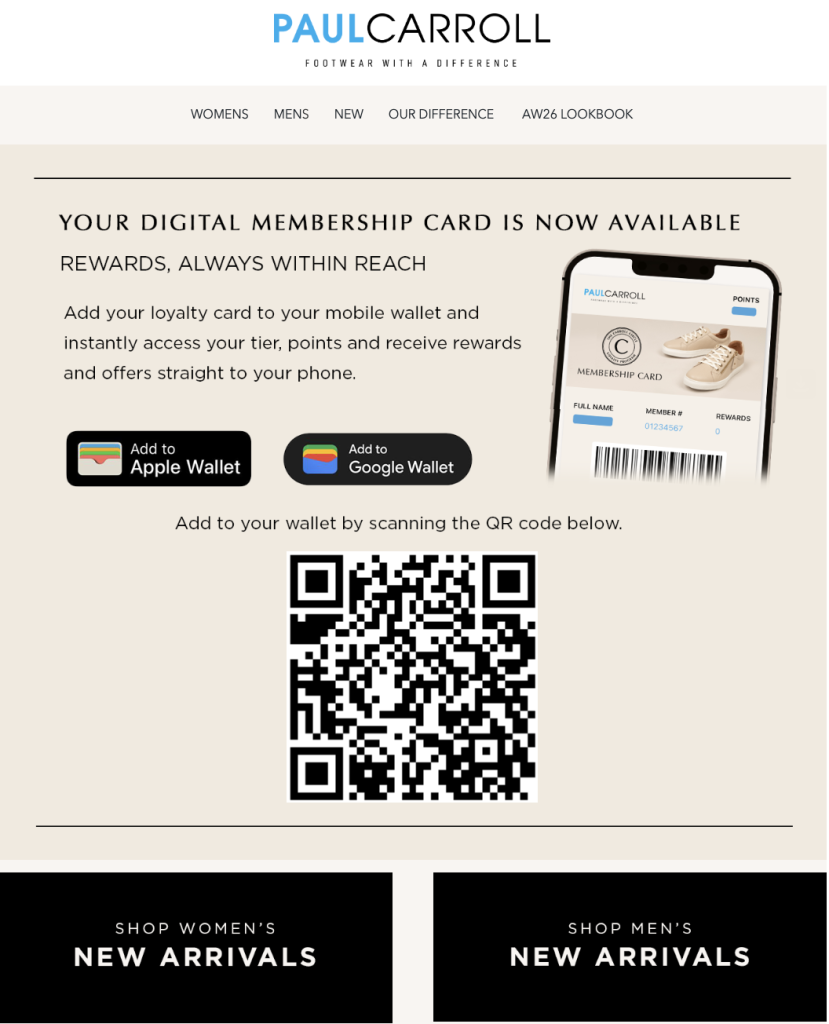
The Paul Carroll membership card sign-up block shown on an email, showing how customers can add the card to Apple Wallet or Google Wallet in one tap.
Why it matters: This is the actual customer-facing page. It shows how low the friction is. There’s no account to create, no app to download. The customer scans the QR code or taps a button, and the card is on their phone.
The card itself shows the customer’s name, member number, points balance, and a scannable barcode that staff can read at the till. It looks and feels like a proper membership card, because it is one. It just happens to live in Apple Wallet or Google Wallet instead of a physical holder.
From the customer’s perspective, the experience is:
- Receive an email or see an in-store prompt to add the digital card
- Tap “Add to Apple Wallet” or “Add to Google Wallet”
- Card is saved. Done.
That’s it. No login. No password. No app download.
How the Distribution Was Set Up
Paul Carroll used Dotdigital as their email platform. The integration between Dotdigital and Litecard meant that the wallet pass download link could be embedded directly inside existing customer communications, such as welcome emails, order confirmations, and loyalty update messages.
This matters because the best time to offer someone a digital membership card is when they’re already engaged, not when you’re cold-reaching them weeks later. A new customer receiving their order confirmation is already in a positive moment. Adding “save your membership card” to that email converts well because the timing is right.
Dotdigital handles the email send. Litecard handles the pass creation and delivery. Each customer gets a unique pass linked to their member record, so the data flowing back is clean and attributable.
What the Brand Controls
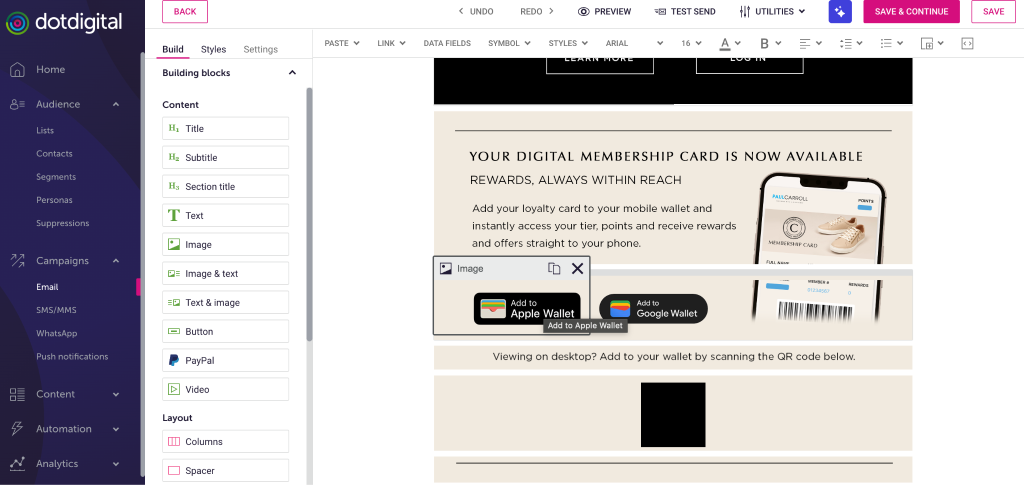
In the CDP/CRM, you can design your email or SMS campaigns to include dynamic content that links to customer meta fields or attributes that Litecard populates. See the above example where the Apple Wallet Link, Google Wallet Link and QR code refer to the meta fields against a customer’s record. Each customer receives their own unique links as per the user journey created within Litecard.
Once the card is saved to a customer’s wallet, Paul Carroll can:
Update the pass dynamically. Points balances, tier status, and promotional messages can be updated without the customer doing anything. The card in their wallet changes automatically.
Send push notifications. This is the channel that most brands are missing. A push notification sent through a wallet pass lands on the customer’s lock screen, without requiring them to be on social media or have their email open. It’s a direct line.
Send location-based notifications. If a customer walks past a Paul Carroll store, the pass can trigger a notification at that moment. The timing relevance alone changes how those messages land.
Track redemption. The barcode on the pass is scanned at the point of sale, so every redemption is recorded. The brand can see which customers came in, when, and how often.
*Hide ‘add to wallet’ content in emails: Once a customer adds a pass to their mobile wallet, Litecard writes to a Dotdigital (or any CDP) field that the pass has been downloaded and now, in all trade and transactional emails, the ‘add-to-wallet’ pass blocks will be hidden for people who have already added to their wallet.
The Setup Process
Getting Paul Carroll live on Litecard involved a few clear steps:
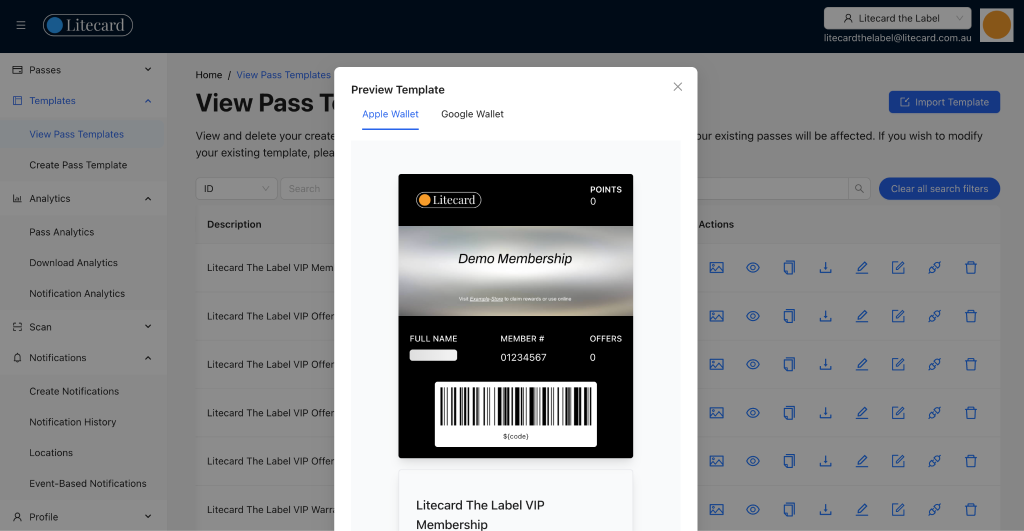
Pass design. The card was designed to match the Paul Carroll brand, using the brand’s typography, colour palette, and visual identity. The pass shows the member’s name, member number, and rewards balance. It’s built to look like something the customer would actually want to keep on their phone.
CRM integration. Connecting Litecard to the existing customer data meant passes could be personalised at scale. Each member gets a card with their own details, not a generic template.
Email flow setup. The wallet pass download link was embedded into Dotdigital email flows, so new members and existing customers received their card through the communication channel they were already using.
Staff training. In-store teams needed to know how to scan the wallet pass barcode at the till. This is straightforward because the barcode behaves the same way as any other scannable code.
Why This Works for a Fashion / Footwear Retailer or Brand
Footwear has a particular challenge with loyalty. Purchase frequency is lower than, say, a coffee shop or a grocery store. A customer might buy two or three times a year. That means there are long gaps where the brand has no touchpoint.
A wallet pass changes the equation. It gives the brand permission to reach that customer between purchases, without being intrusive. A notification about a new season launch, a birthday reward, or an expiring offer can land at the right moment and prompt a visit.
The card is also always accessible at the point of sale. The customer doesn’t have to remember a code, find an email, or open an app. They open their wallet, tap the card, and scan. That’s the kind of frictionless experience that makes loyalty programmes actually stick.
What This Looks Like at Scale Commercially
Paul Carroll is one brand, but these numbers show what happens when the same mechanics are applied at scale across retail customers. The fundamentals are the same: a card in the wallet, a direct notification channel, measurable redemption.
The Litecard model is built around a simple ROI calculation. If a brand has 200,000 members receiving 24 notifications a year, and even 10% click through and 10% of those purchase, that’s a significant number of incremental orders. With an average order value of $160, the numbers add up quickly without requiring any changes to the product, the store, or the existing marketing stack.
The Practical Takeaway
What Paul Carroll did is replicable for most retail brands with an existing loyalty or membership programme.
The starting point is the customer list you already have. The integration with your existing email platform handles distribution. The pass design takes a matter of days, not months. And once it’s live, the channel is there to use indefinitely.
No app. No rebuild of your CRM. No disruption to the customer journey you already have.
It’s an additional channel that sits on top of what you’re already doing, reaches customers at moments that matter, and gives you a data trail that connects the notification to the sale.
That’s the point of a digital membership card done properly.
Litecard works with retail brands, hospitality operators, and loyalty programmes to launch wallet passes across Apple Wallet and Google Wallet. If you’re running a membership or loyalty programme and want to see how this would work for your brand, get in touch.


